Understanding Density: Why Mass and Volume Are Fundamentally Different
An authoritative engineering guide explaining the physics of density, thermal expansion coefficients, Archimedes buoyancy, and why kilograms and gallons require fluid-specific conversion factors.
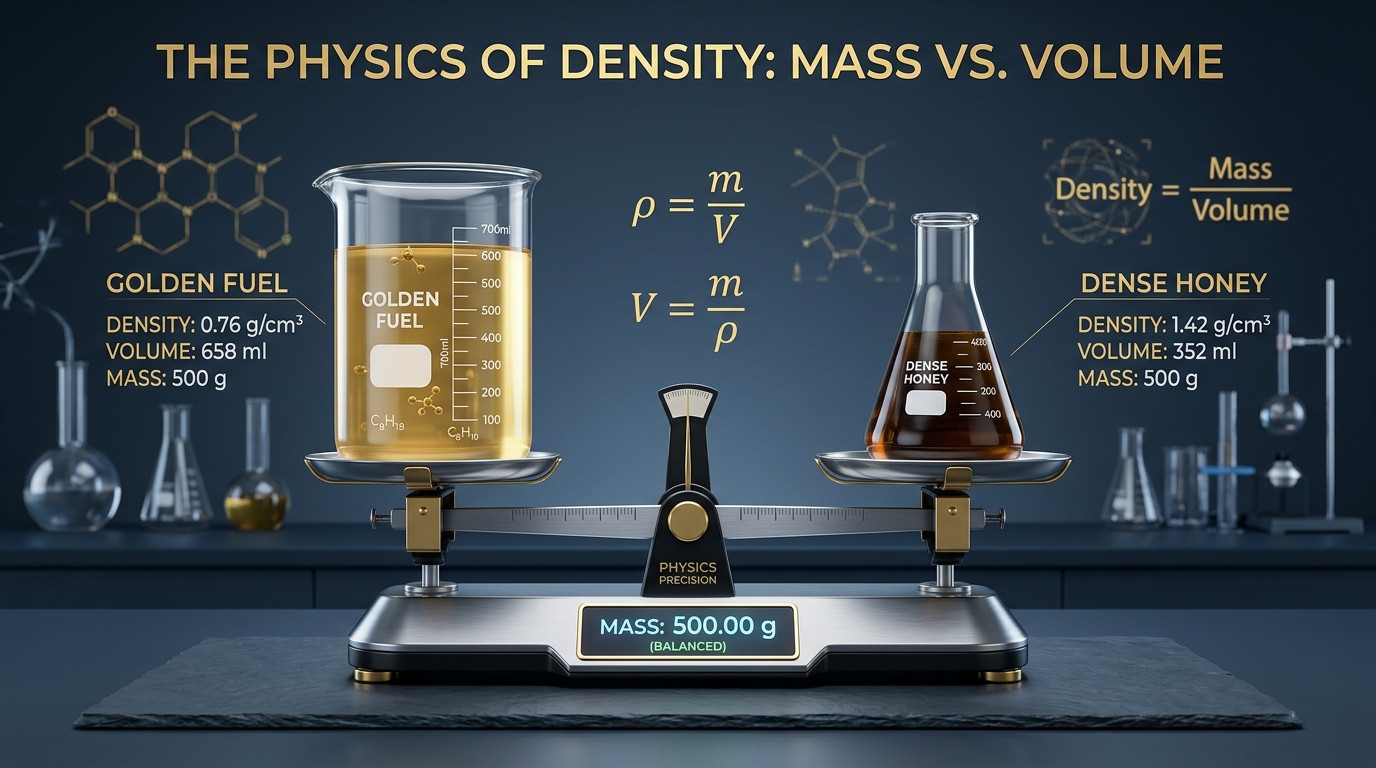
Understanding Density: Why Mass and Volume Are Fundamentally Different
In everyday language, people routinely interchange mass and volume. Someone might refer to “a heavy bucket of paint” while specifying a 5-gallon container, or ask for “10 kilograms of diesel” expecting a fuel attendant to dispense an exact number of gallons.
However, in mechanical engineering, chemical manufacturing, aviation, and metrology, confusing mass and volume is one of the most hazardous and financially expensive mistakes a technician or engineer can make.
Kilograms (kg) and gallons (gal) measure fundamentally separate physical dimensions:
- Mass (m) is the fundamental measure of the amount of matter in a substance, quantified in SI units of kilograms. Mass is invariant under changes in temperature, ambient pressure, or elevation. A 10 kg block of steel has the exact same mass whether placed in an arctic laboratory, heated in an industrial furnace, or transported to the Moon.
- Volume (V) is a derived geometric quantity that measures the three-dimensional space occupied by that matter, quantified in cubic meters (m^3), liters (L), or gallons (gal). Unlike mass, liquid and gas volumes expand and contract continuously with every fluctuation in ambient temperature and pressure.
To translate between mass and volume, one must bridge these two dimensions through a third physical property: density (ρ).
1. The Fundamental Physics: Deriving the Mass-Volume Bridge
Density is defined by the classical equation:
Density (ρ) = Mass (m) / Volume (V)Rearranging this formula to solve for volume yields:
Volume (V) = Mass (m) / Density (ρ)In the International System of Units (SI), mass is measured in kilograms (kg) and volume is measured in cubic meters (m^3) or cubic decimeters (liters, L). Because 1 liter = 0.001 m^3, measuring density in kilograms per liter (kg/L) or grams per cubic centimeter (g/cm^3) provides a convenient 1:1 numerical scale:
1 kg/L = 1 g/cm^3 = 1,000 kg/m^3The Imperial Dilemma: Three Different Gallons
When bridging metric kilograms into imperial volume units, a critical complication arises: which gallon are you measuring? The world uses three distinct units named “gallon”:
- US Liquid Gallon: Defined by the United States National Institute of Standards and Technology (NIST) as exactly 231 cubic inches, which equals:
1 US Liquid Gallon = 3.785411784 Liters = 0.003785412 m³ - Imperial Gallon (UK / Commonwealth): Defined under the British Weights and Measures Act as the exact volume of 10 pounds of distilled water weighed in air with brass weights at 62°F (16.67°C):
1 Imperial Gallon = 4.54609 Liters ≈ 1.20095 US Liquid Gallons - US Dry Gallon: Used primarily in agricultural commodities (such as grain or berries), defined as 1/8th of a US bushel:
1 US Dry Gallon = 268.8025 cubic inches ≈ 4.4048838 Liters
Because commercial pumps, fuel meters, and tank level indicators in North America utilize the US Liquid Gallon, the exact mathematical formula to convert mass in kilograms into US liquid gallons is:
Volume (US Gallons) = Mass (kg) / [ Density (kg/L) × 3.785411784 ]Or equivalently, calculating the effective density in pounds per gallon:
Density (lbs/gal) = Density (kg/L) × 8.345404
Volume (US Gallons) = [ Mass (kg) × 2.20462262 ] / Density (lbs/gal)
2. Real-World Substance Comparison: 100 kg Across Five Common Liquids
To see why a universal conversion factor cannot exist, examine what happens when an automated dispenser fills containers with exactly 100.0 kilograms of five everyday industrial fluids at 15°C (59°F):
| Substance | Category | Density (ρ) @ 15°C | Volume in Liters | Volume in US Gallons | Volume in Imperial Gallons |
|---|---|---|---|---|---|
| Liquid Propane (LPG) | Liquefied Gas | 0.493 kg/L | 202.84 L | 53.58 gal | 44.62 gal |
| Aviation Gasoline (Avgas 100LL) | Aviation Fuel | 0.720 kg/L | 138.89 L | 36.69 gal | 30.55 gal |
| Automotive Diesel #2 (ULSD) | Transportation | 0.832 kg/L | 120.19 L | 31.75 gal | 26.44 gal |
| Pure Distilled Water | Reference Fluid | 1.000 kg/L | 100.00 L | 26.42 gal | 21.99 gal |
| Pure Raw Honey | Viscous Food | 1.420 kg/L | 70.42 L | 18.60 gal | 15.49 gal |
Notice the dramatic disparity: 100 kilograms of liquid propane fills 53.58 US gallons, whereas 100 kilograms of raw honey fills only 18.60 US gallons. If a chemical plant or freight hauler used a water conversion factor (26.42 gal) for propane, the tank would overflow by more than 100%, creating an immediate explosion hazard!
3. How Density Is Measured: Hydrometers, Pycnometers & Archimedes’ Principle
In laboratory and industrial environments, determining accurate density requires specialized instrumentation calibrated to international metrology standards.
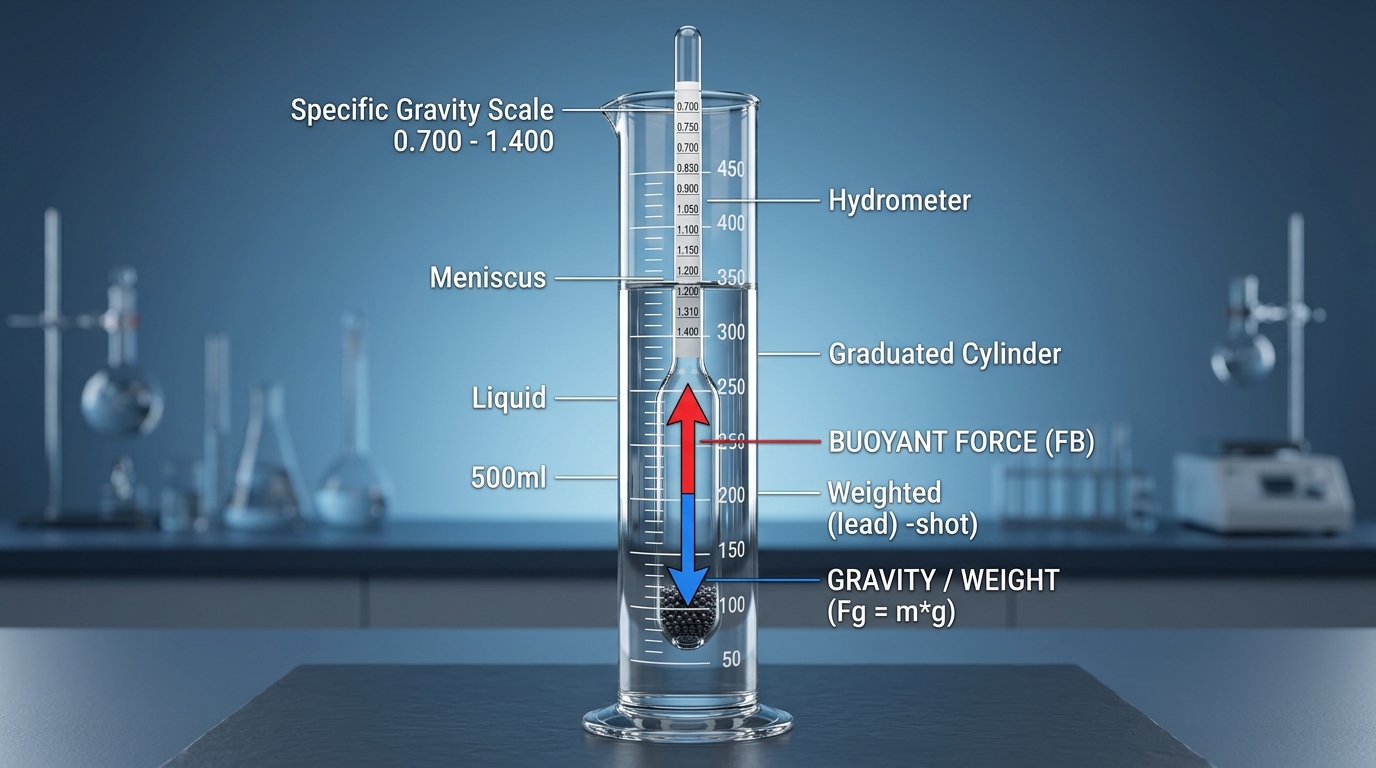
Archimedes’ Principle & The Hydrometer
The most common tool for measuring liquid density is the glass hydrometer. A hydrometer operates on Archimedes’ Principle, which states that any body completely or partially submerged in a fluid is buoyed up by a force equal to the weight of the fluid displaced by the body:
F_buoyant = ρ_fluid × V_displaced × gWhen placed inside a graduated glass cylinder containing the test fluid:
- In a dense fluid (like honey or saltwater), the fluid exerts a high buoyant force per unit depth. The hydrometer floats high in the cylinder.
- In a light fluid (like gasoline or acetone), the fluid exerts a lower buoyant force. The hydrometer sinks deeper until the mass of the displaced liquid equals the instrument’s total weight.
- The graduated scale at the surface meniscus displays the Specific Gravity (SG) or direct density.
Pycnometers and Digital Oscillating U-Tubes
For extreme accuracy in chemical plants and fuel certification labs:
- Pycnometers: A precision-machined glass or stainless steel vessel of calibrated volume with a capillary stopper. The vessel is weighed empty, filled with the test liquid, and weighed on an analytical balance accurate to 0.0001 grams.
- Oscillating U-Tube Densitometers (ASTM D4052): An electronically excited hollow U-tube vibrates at its natural harmonic frequency. When filled with liquid, the frequency shifts in direct proportion to the fluid mass, yielding instant digital density readings accurate to 0.00001 g/cm³.
4. Temperature Dependence: Thermal Expansion and Volume Drift
Density is not a static number—it changes whenever temperature changes. When a liquid heats up, its molecules absorb kinetic energy and vibrate more vigorously, pushing each other further apart. The mass remains completely unchanged, but the liquid expands in volume, lowering its density.
The volumetric expansion can be modeled with the volumetric thermal expansion coefficient (β):
V(T) = V_0 [ 1 + \beta (T - T_0) ]ρ(T) ≈ (ρ_0) / (1 + \beta (T - T_0))Typical Thermal Expansion Coefficients (β) of Common Fluids:
- Liquid Propane: β ≈ 0.0030 /°C (extremely high thermal expansion)
- Gasoline / Jet Fuel: β ≈ 0.0010 /°C
- Diesel Fuel #2: β ≈ 0.0008 /°C
- Water @ 20°C: β ≈ 0.00021 /°C
What This Means in Everyday Practice:
If you purchase 1,000 US gallons of diesel fuel on a freezing winter morning at -5°C (23°F), that fuel has a density of approximately 0.846 kg/L, weighing 3,202 kg.
If that same fuel warms to 35°C (95°F) in an above-ground storage tank during a summer heatwave, its density drops to 0.818 kg/L. The exact same 3,202 kg of diesel molecules now occupies 1,034 US gallons—an expansion of 34 gallons purely due to temperature!
This physical phenomenon is why commercial fuel terminals, pipeline operators, and aviation fuel providers conduct commercial billing based on temperature-compensated net gallons at standard 60°F (15°C) rather than raw ambient meter volume.
5. Comprehensive Density Reference Table: 25 Common Industrial Substances
Use this engineering reference table for quick calculations. All values are calibrated at standard reference conditions (15°C / 60°F and 1 atm):
| Substance | Category | Density (kg/L) | Weight (lbs/gal) | 100 kg to US Gal | 100 US Gal to kg |
|---|---|---|---|---|---|
| Liquid Propane (LPG) | Liquefied Gas | 0.493 | 4.11 | 53.58 gal | 186.6 kg |
| Liquid Butane | Liquefied Gas | 0.573 | 4.78 | 46.10 gal | 216.9 kg |
| Ethanol (Pure Ethyl Alcohol) | Alcohol | 0.789 | 6.58 | 33.48 gal | 298.7 kg |
| Methanol (Methyl Alcohol) | Alcohol | 0.792 | 6.61 | 33.35 gal | 299.8 kg |
| Acetone | Solvent | 0.791 | 6.60 | 33.39 gal | 299.4 kg |
| Aviation Gasoline (Avgas 100LL) | Aviation | 0.720 | 6.01 | 36.69 gal | 272.5 kg |
| Motor Gasoline (Regular 87) | Automotive | 0.745 | 6.22 | 35.46 gal | 282.0 kg |
| Jet A / Jet A-1 Turbine Fuel | Aviation | 0.804 | 6.71 | 32.85 gal | 304.3 kg |
| Kerosene (Standard #1-K) | Heating/Fuel | 0.810 | 6.76 | 32.61 gal | 306.6 kg |
| Diesel Fuel #2 (ULSD) | Transportation | 0.832 | 6.94 | 31.75 gal | 314.9 kg |
| Biodiesel (B100 Pure FAME) | Biofuel | 0.880 | 7.34 | 30.02 gal | 333.1 kg |
| Engine Motor Oil (SAE 10W-40) | Lubricant | 0.875 | 7.30 | 30.19 gal | 331.2 kg |
| Hydraulic Fluid (ISO VG 46) | Industrial | 0.870 | 7.26 | 30.36 gal | 329.3 kg |
| Canola / Vegetable Cooking Oil | Food Oil | 0.920 | 7.68 | 28.71 gal | 348.3 kg |
| Extra Virgin Olive Oil | Food Oil | 0.918 | 7.66 | 28.78 gal | 347.5 kg |
| Distilled Pure Water (4°C) | Reference | 1.000 | 8.345 | 26.42 gal | 378.5 kg |
| Tap Water (20°C / 68°F) | Reference | 0.998 | 8.33 | 26.47 gal | 377.8 kg |
| Seawater (3.5% Salinity) | Marine | 1.025 | 8.55 | 25.77 gal | 388.0 kg |
| Whole Bovine Milk (3.7% Fat) | Dairy | 1.032 | 8.61 | 25.60 gal | 390.7 kg |
| Ethylene Glycol (Antifreeze) | Chemical | 1.113 | 9.29 | 23.73 gal | 421.3 kg |
| Propylene Glycol (Coolant) | Chemical | 1.036 | 8.65 | 25.50 gal | 392.2 kg |
| Glycerol / Pure Glycerin | Chemical | 1.261 | 10.52 | 20.95 gal | 477.3 kg |
| Maple Syrup (Grade A, 66° Brix) | Food/Sweetener | 1.330 | 11.10 | 19.86 gal | 503.5 kg |
| Pure Raw Honey (17% Moisture) | Food/Sweetener | 1.420 | 11.85 | 18.60 gal | 537.5 kg |
| Sulfuric Acid (98% Technical) | Chemical Acid | 1.840 | 15.36 | 14.36 gal | 696.5 kg |
6. Step-by-Step Mathematical Worked Examples
Example 1: Converting Diesel Fuel Mass on an Industrial Scale
Scenario: An off-grid mining generator site receives a bulk fuel delivery recorded on a weighbridge scale as 14,250 kg net mass of ULSD Diesel #2. The site manager needs to know how many US liquid gallons will enter the bulk storage tank.
- Identify the reference density: Standard Diesel #2 has a density of 0.832 kg/L at 15°C.
- Convert Mass to Liters:
Volume (L) = (Mass (kg)) / (Density (kg/L)) = (14,250) / (0.832) = 17,127.40 Liters
3. **Convert Liters to US Gallons**:
   ```text
Volume (US Gal) = (17,127.40 L) / (3.785411784 L/gal) = 4,524.58 US Gallons- Verification via Pounds per Gallon:
Weight in lbs = 14,250 × 2.20462262 = 31,415.87 lbs
   ```text
Diesel density in lbs/gal = 0.832 × 8.345404 = 6.943 lbs/gal
Gallons = (31,415.87) / (6.943) = 4,524.8 US Gallons(Both methods match within 0.005% rounding tolerance).
Example 2: Sizing Storage Totes for High-Density Honey Bottling
Scenario: A commercial beekeeping cooperative harvested 3,500 kg of pure raw clover honey. They intend to purchase 55-gallon steel drums. How many drums are required?
- Identify the reference density: Pure raw honey with 17% water content has a density of 1.420 kg/L.
- Calculate Total Volume in Liters:
Volume (L) = (3,500 kg) / (1.420 kg/L) = 2,464.79 Liters
3. **Calculate Total Volume in US Gallons**:
   ```text
Volume (US Gal) = (2,464.79) / (3.785411784) = 651.13 US Gallons- Determine Drum Requirement:
Drums Needed = (651.13 gal) / (55 gal/drum) = 11.84 drums
   The cooperative must order **12 full 55-gallon drums**. The 12th drum will be filled to approximately 46.2 gallons (84\% capacity).

---

## 7. Costly Metrological Pitfalls in Engineering

Failure to account for substance density and temperature creates severe commercial and legal liabilities:

1. **The "Water Multiplier" Trap**: Many amateur spreadsheets apply the water density constant (1 kg = 1 L = 0.264172 gal) universally to all liquids. Applying this to light fuels results in under-reporting volume by up to 50\%, while applying it to syrups causes chronic tank overfill.
2. **Billing Mismatches in Commercial Logistics**: When bulk liquid chemicals are invoiced based on gross weight over truck scales but discharged through positive-displacement volumetric flow meters, uncorrected temperature variances cause inventory discrepancies of thousands of dollars per delivery.
3. **Overfilling Closed Vessels**: Liquids are virtually incompressible. If a tank or pipeline is filled to 100% capacity with cold fluid and sealed without vapor expansion space or pressure relief valves, subsequent ambient warming will cause hydrostatic pressure spikes capable of rupturing steel flanges and welds.

---

## 8. Frequently Asked Questions (FAQ)

### Can I convert kg to gallons without knowing the liquid?
No. Kilograms measure mass (weight), while gallons measure physical 3D volume. You cannot calculate gallons without knowing what fluid is in the container and its specific density. For example, 10 kg of light propane fills 5.36 gallons, while 10 kg of heavy mercury fills only 0.19 gallons.

### Why do European fuel stations sell in liters while aircraft dispatchers calculate in kilograms?
Fuel dispensers measure liquid passing through volumetric flow meters directly into vehicle tanks, which is convenient for consumer retail pricing in liters. However, commercial aircraft must know the exact weight of fuel loaded aboard to ensure the aircraft does not exceed its Maximum Takeoff Weight (MTOW), to calculate the center of gravity, and to compute engine thrust requirements for climb performance.

### How does salinity alter the density of water?
Dissolved salts increase water density. Pure fresh water at 4°C has a density of 1.000 kg/L (8.345 lbs/gal). Standard oceanic seawater contains approximately 3.5\% dissolved mineral salts, raising its density to 1.025 kg/L (8.55 lbs/gal). Hyper-saline water in the Dead Sea reaches 1.24 kg/L, allowing humans to float with effortless buoyancy.

### What is the difference between Specific Gravity and Density?
Density is an absolute measurement expressed in physical units (such as kg/L or g/cm^3). Specific Gravity (SG) is a dimensionless ratio comparing the density of a test substance to the density of pure distilled water at 4°C (1.000 kg/L). Because water density in SI units is 1.000, a substance with a density of 0.832 kg/L has a specific gravity of exactly 0.832.

---

## Summary & Next Steps

When calculating liquid volume from scale weight:
1. Always confirm the specific fluid and its chemical grade.
2. Determine the fluid's operating temperature and reference density in kg/L.
3. Divide the mass in kilograms by the product of density and 3.785411784.
4. Double-check whether your application calls for US Liquid Gallons or UK Imperial Gallons.

Use our free interactive tools to automate your calculations with certified ASTM, NIST, and ISO density databases:
- [Universal Kg to Gallons Converter](/)
- [Substance Density Database & Converter](/density-converter/)
- [US Liquid vs Imperial Gallons Guide](/kg-to-imperial-gallons/)Perform Precision Mass-to-Volume Conversions
Use our live calculators calibrated to official ASTM, NIST, and NFPA temperature and density standards.