Propane Tank Sizing Guide: Calculating Gallons from Cylinder Weight (KG)
The complete technical guide to calculating liquid propane gallons from scale weight in kilograms or pounds, NFPA 58 80% fill rules, tare weight decoding, and burn time formulas.
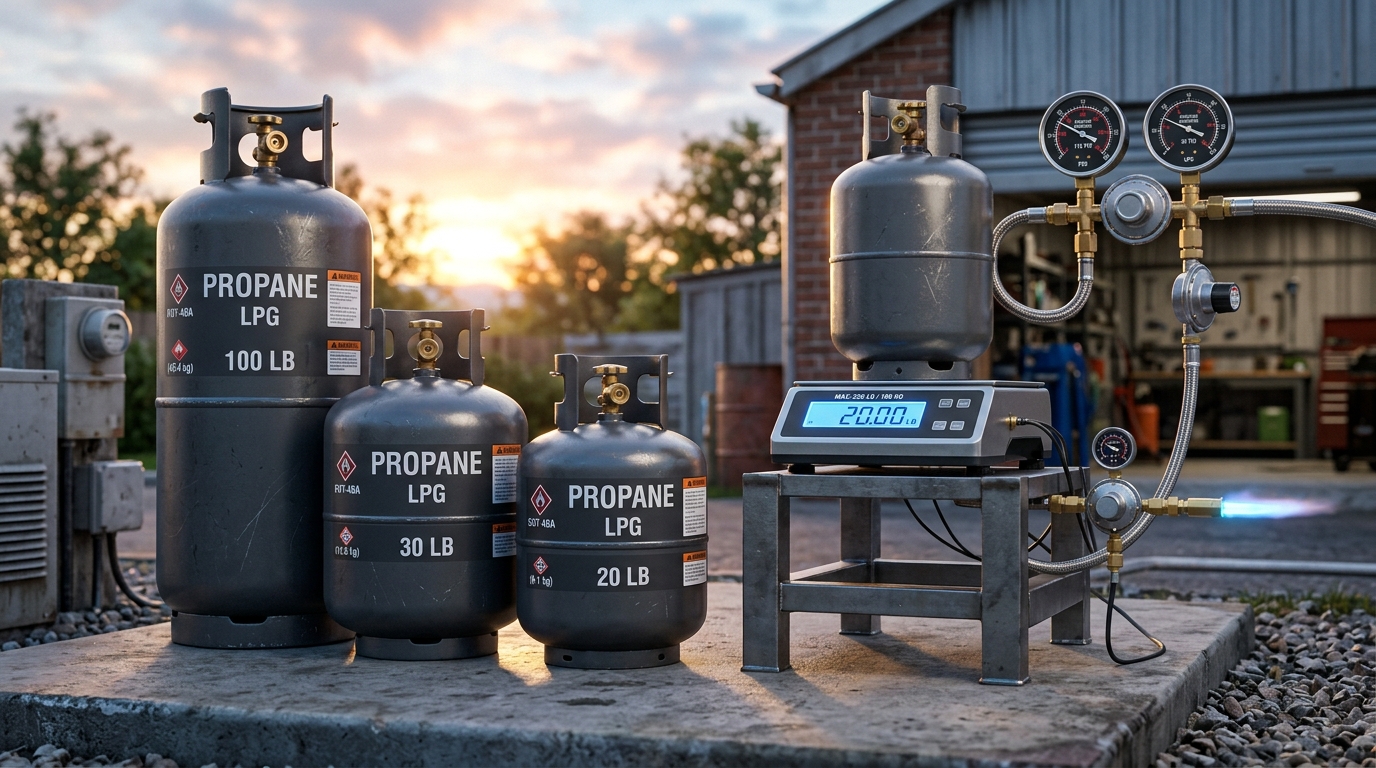
Propane Tank Sizing Guide: Calculating Gallons from Cylinder Weight (KG)
Whether managing a commercial forklift fleet, powering an off-grid RV trailer, or grilling outdoors, propane (liquefied petroleum gas, or LPG) is one of the world’s most versatile fuels. Yet despite its ubiquity, propane quantity is a frequent source of confusion: fuel is purchased and delivered by the gallon, but cylinders are weighed on scales in kilograms or pounds.
Because liquid propane is compressed inside thick steel vessels under high pressure, you cannot tap the side or visually inspect the fluid level. Furthermore, pressure gauges cannot tell you how much liquid fuel remains in your tank until the liquid has completely evaporated!
This comprehensive technical guide explains the underlying physics of LPG, how to decode cylinder tare weight stamps, how to calculate exact gallons remaining using scale weight, and why the NFPA 58 80% safety rule governs every propane fill worldwide.
1. Physical Properties of Liquid Propane (C_3H_8)
Propane is a hydrocarbon that exists as a gas at atmospheric pressure and normal ambient temperatures. However, under moderate pressure (or when refrigerated below -42°C / -44°F), it compresses into a clear, colorless liquid.
Key physical constants certified by the National Institute of Standards and Technology (NIST) and ASTM D1835 include:
- Density @ 15°C (60°F): 0.493 kg/L to 0.505 kg/L (nominal engineering standard: 0.493 kg/L)
- Density in Imperial Units: 4.11 to 4.24 lbs per US liquid gallon (nominal standard: 4.20 lbs/gal)
- 1 kg of Liquid Propane: Equals 0.5358 US Gallons (2.028 Liters)
- 1 US Gallon of Liquid Propane: Equals 1.866 Kilograms (4.20 Pounds)
- Liquid-to-Vapor Expansion Ratio: 1:270 (1 gallon of liquid vaporizes into 270 gallons of burnable gas)
- Heat of Combustion (Energy Density): 91,547 BTU per US gallon (21,548 BTU/lb or 50,300 kJ/kg)
2. The NFPA 58 80% Safety Rule & OPD Valves
A critical safety regulation defined by the National Fire Protection Association (NFPA 58: Liquefied Petroleum Gas Code) is that no portable or stationary propane container may be filled beyond 80% of its total water capacity (WC).
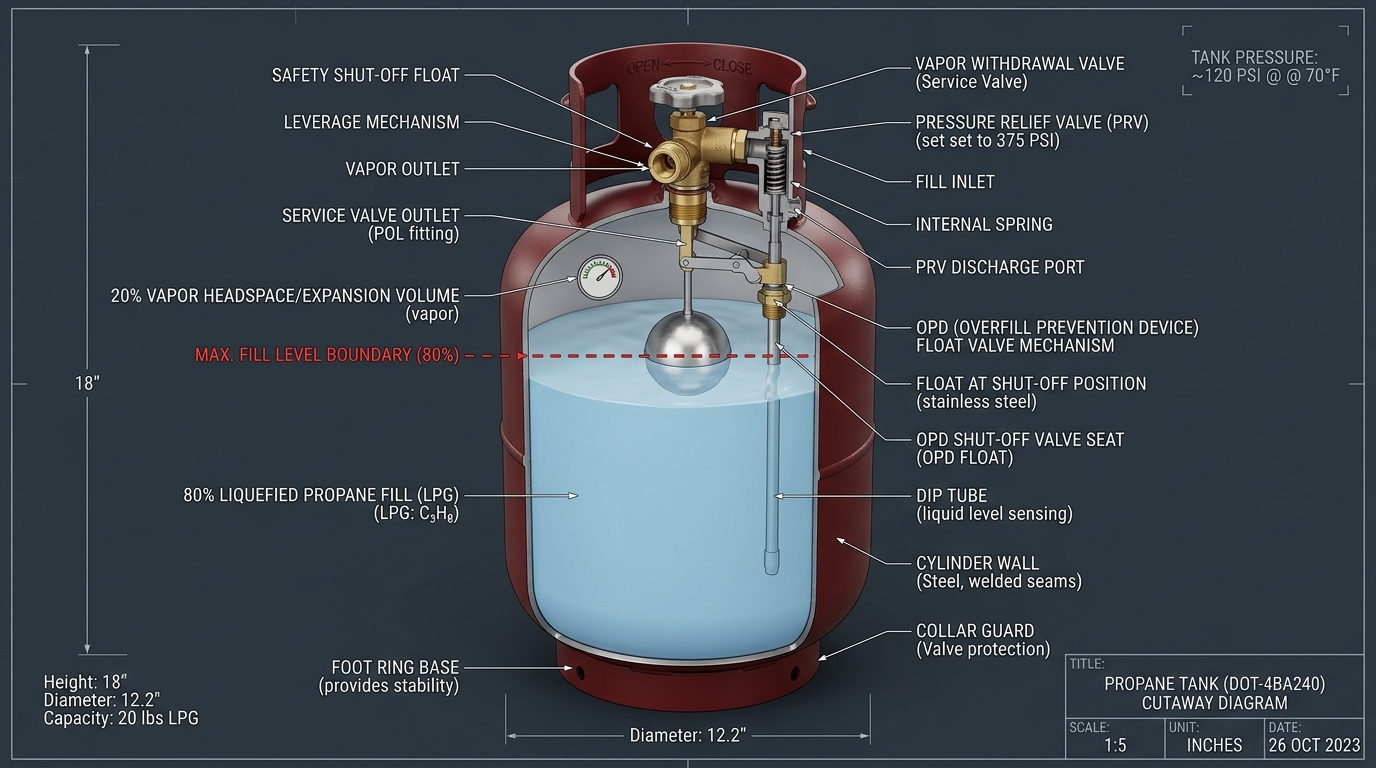
Why Tanks Are Never Filled to 100%
Liquid propane possesses a coefficient of thermal expansion roughly 17 times greater than water. When the ambient temperature rises:
- The liquid expands rapidly in volume.
- If a tank were filled 100% with cold liquid propane at 10°C (50°F) and left in the summer sun at 38°C (100°F), the expanding liquid would fill the cylinder completely.
- Because liquids are virtually incompressible, hydraulic pressure would instantly escalate from normal working pressure (~150 psi) to catastrophic levels exceeding 1,000 psi, triggering the pressure relief valve (PRV) or rupturing the steel shell.
The Overfill Prevention Device (OPD)
Modern consumer cylinders (up to 40 lbs / 18 kg) are fitted with a triangular valve handwheel indicating an OPD (Overfill Prevention Device). Inside the cylinder, a float assembly rides atop the liquid surface. When the liquid level reaches exactly 80% of cylinder capacity, the float actuates an internal shuttle valve, shutting off the fill port regardless of pump pressure.
3. Decoding Cylinder Collar Stamping: TW, WC, and DT
Every Department of Transportation (DOT) certified propane cylinder has critical technical specifications permanently stamped into the protective steel collar. To calculate fuel quantity, you must locate these values:
       ┌────────────────────────────────────────────────────┐
       │   DOT-4BA240   M1004   06/25                        │
       │   TW 16.6     WC 47.6 lb     DT 4.2                │
└────────────────────────────────────────────────────┘- TW (Tare Weight): The empty weight of the cylinder, including the steel body, foot ring, collar, and brass service valve. A standard steel 20 lb BBQ cylinder typically has a tare weight stamped between 16.6 lbs (7.53 kg) and 18.0 lbs (8.16 kg).
- WC (Water Capacity): The total weight of pure water the cylinder could physically hold if filled to 100% brimful capacity. Because propane’s specific gravity is approximately 0.42 relative to water, the legal 80% propane fill limit is calculated as:
Max Propane Capacity (lbs) = WC × 0.42
   For a standard BBQ cylinder with WC = 47.6 lbs:
   ```text
47.6 × 0.42 = 19.99 lbs ≈ 20.0 lbs of Propane (9.07 kg)- DT (Dip Tube Length): The length of the internal fixed liquid level gauge tube in inches (e.g., DT\ 4.2).
4. Comprehensive Propane Cylinder & Tank Sizing Chart
The table below outlines standard cylinder sizes, showing both gross certified capacities and actual usable fuel metrics:
| Cylinder / Tank Type | Water Capacity (WC) | Legal Max Propane (kg) | Legal Max Propane (lbs) | Actual Liquid Fill (US Gal) | Total Energy (BTU) | Primary Applications |
|---|---|---|---|---|---|---|
| 20 lb Grill Tank | 47.6 lbs (21.6 kg) | 9.07 kg | 20.0 lbs | 4.76 gal | 435,760 BTU | BBQ grills, patio heaters, camping |
| 30 lb RV Cylinder | 71.4 lbs (32.4 kg) | 13.61 kg | 30.0 lbs | 7.14 gal | 653,640 BTU | Travel trailers, motorhomes, space heaters |
| 40 lb Commercial | 95.2 lbs (43.2 kg) | 18.14 kg | 40.0 lbs | 9.52 gal | 871,520 BTU | Commercial heaters, roofers, large RVs |
| 33.5 lb Forklift Tank | 80.0 lbs (36.3 kg) | 15.20 kg | 33.5 lbs | 7.98 gal | 730,540 BTU | Warehouse forklifts (liquid withdrawal) |
| 100 lb (45 kg) Cylinder | 238.1 lbs (108 kg) | 45.36 kg | 100.0 lbs | 23.81 gal | 2,179,730 BTU | Fireplaces, backup generators, cabins |
| 120 Gallon Torpedo | 1,000 lbs (454 kg) | 190.5 kg | 420.0 lbs | 96.0 gal | 8,788,500 BTU | Domestic hot water, whole-home cooking |
| 250 Gallon ASME | 2,085 lbs (946 kg) | 396.9 kg | 875.0 lbs | 200.0 gal | 18,309,400 BTU | Home heating (mild climates), pool heaters |
| 500 Gallon ASME | 4,170 lbs (1,891 kg) | 793.8 kg | 1,750.0 lbs | 400.0 gal | 36,618,800 BTU | Full residential whole-home central heating |
| 1,000 Gallon ASME | 8,340 lbs (3,783 kg) | 1,587.6 kg | 3,500.0 lbs | 800.0 gal | 73,237,600 BTU | Commercial agriculture, large estates |
5. The Exact Math: How to Calculate Gallons from Scale Weight
To find exactly how many gallons of propane remain in your tank, place the cylinder on any calibrated luggage scale, bathroom scale, or platform scale:
The Mathematical Formula:
Step 1: Net Propane Weight (kg) = Total Scale Reading (kg) - Stamped Tare Weight (kg)
Step 2: Remaining Gallons = Net Propane Weight (kg) × 0.53584
Or if your scale reads in pounds (lbs):
Step 1: Net Propane Weight (lbs) = Total Scale Reading (lbs) - Stamped Tare Weight (lbs)
Step 2: Remaining Gallons = Net Propane Weight (lbs) / 4.20
Real-World Calculation Example:
You place your 20 lb BBQ propane cylinder on a digital scale before hosting a gathering.
- Scale Reading: 13.2 kg (29.1 lbs)
- Stamped Collar Tare Weight (TW): 7.7 kg (17.0 lbs)
Calculation:
- Net Propane Mass:
Net Propane = 13.2 kg - 7.7 kg = 5.5 kg (12.1 lbs)
2. **Convert Net Kilograms to Liquid Gallons**:
   ```text
Gallons Remaining = 5.5 kg × 0.53584 = 2.95 US Gallons- Determine Percentage Full:
% Full = ≤ft( (2.95 gal) / (4.76 gal maximum capacity) ) × 100 = 62%
---

## 6. Burn Time Formulas: How Long Will Your Remaining Fuel Last?

Propane appliances are rated by their hourly heat consumption in **BTUs per hour (BTU/hr)**. Because one gallon of propane yields **91,547 BTU**, you can calculate runtime using this exact formula:

```text
Runtime (Hours) = (Remaining Propane Gallons × 91,547) / (Appliance BTU/hr Rating)
Estimated Runtimes for Common Appliances on a Standard 20 lb Tank (4.76 gal Full):
| Appliance | Heat Consumption Rating | Total Full Tank Burn Time | Burn Time per 1 kg of Fuel |
|---|---|---|---|
| Outdoor BBQ Grill (3 Burners on Med) | 30,000 BTU/hr | 14.5 Hours | 1.60 Hours |
| Patio Flame Heater (High Setting) | 40,000 BTU/hr | 10.9 Hours | 1.20 Hours |
| Camp Stove (Dual 10k Burners) | 20,000 BTU/hr | 21.8 Hours | 2.40 Hours |
| RV High-Efficiency Furnace | 25,000 BTU/hr | 17.4 Hours | 1.92 Hours |
| Emergency Home Generator (5.5 kW) | 65,000 BTU/hr | 6.7 Hours | 0.74 Hours |
| Whole-Home Central Furnace | 100,000 BTU/hr | 4.3 Hours | 0.48 Hours |
7. Why Pressure Gauges Cannot Measure Fuel Volume
A widespread consumer misconception is purchasing screw-on pressure gauges expecting them to indicate tank volume like a vehicle fuel gauge.
In a closed pressurized container, liquid propane and vaporized propane exist in dynamic thermodynamic equilibrium. As long as any liquid remains in the tank (whether 90% full or 2% full), the vapor pressure inside the cylinder is determined solely by the ambient temperature, not by the amount of fuel!
Saturated Propane Vapor Pressure vs Temperature:
- -40°C (-40°F): 0 psi (propane will not boil or flow without vapor boost)
- 0°C (32°F): 54 psi
- 20°C (68°F): 124 psi
- 38°C (100°F): 172 psi
- 54°C (130°F): 257 psi
A pressure gauge will read 124 psi at 20°C whether the tank contains 4.5 gallons or 2 spoonfuls of liquid. The pressure gauge needle only drops when the last drop of liquid has completely evaporated and the remaining vapor begins depleting. Weighing the tank on a scale is the only reliable method to determine liquid fuel inventory.
8. Cylinder Inspection & DOT Recertification Rules
Portable steel propane cylinders operate under severe pressurized duty cycles. In the United States and Canada, cylinders are governed by DOT and Transport Canada regulations:
- 12-Year Manufacturing Validity: A newly manufactured DOT cylinder is certified for 12 years from the stamped manufacture date (e.g.,
04-24indicates April 2024, valid until April 2036). - Recertification Intervals: Once expired, a cylinder must be inspected and requalified:
- Visual Recertification (
Estamp): Extended for 5 years by a certified inspector. - Hydrostatic Proof Pressure Recertification (
Sstamp): Extended for 7 to 10 years.
- Visual Recertification (
- Rejection Criteria: Refilling stations are legally required to refuse cylinders exhibiting:
- Severe pitting, gouging, or corrosion along the bottom foot ring.
- Dents or deformations on the pressure vessel sidewall.
- Damaged, rounded, or leaking OPD valve threads.
- Outdated requalification dates.
9. Frequently Asked Questions (FAQ)
Why do propane exchange cages give only 15 lbs instead of 20 lbs?
Commercial propane exchange kiosks (such as Blue Rhino or Amerigas) typically fill standard 20 lb cylinders to 15.0 lbs (6.80 kg / 3.57 gallons) rather than the full 20.0 lb capacity. This represents an ~75% fill of maximum capacity. Refilling your cylinder at a dedicated propane dispensing station ensures you receive the full certified 20.0 lb (4.76 gallon) fill, giving you 33% more fuel per trip.
Can I leave my propane tank in the car on a hot day?
Never transport or store a propane tank in an enclosed passenger vehicle or hot trunk. Ambient temperatures inside a parked vehicle in the sun can quickly exceed 60°C (140°F). The expanding liquid propane will force internal pressure beyond the 250–312 psi threshold of the safety relief valve, venting flammable propane vapor directly into your vehicle interior.
How do I convert propane weight in kg directly to liters?
Divide the net kilograms by 0.493 kg/L (or multiply net kg by 2.0284). For example, 9.07 kg of net propane equals:
9.07 × 2.0284 = 18.40 LitersHow can I tell if my propane tank is empty without a scale?
The “warm water trick”: Pour a cup of warm water down the exterior side of the steel cylinder. Run your bare hand vertically down the wet steel. The portion of the tank containing vapor will feel warm to the touch, while the portion containing liquid propane will feel noticeably cold. The boundary line where the temperature shifts indicates the liquid level.
Summary & Conversion Shortcuts
When checking your propane cylinder:
- Locate the TW stamp on the steel collar (usually 16.6 to 18.0 lbs / 7.5 to 8.2 kg).
- Weigh the cylinder on a scale.
- Subtract TW from the total scale reading to get net propane weight.
- Multiply net kg by 0.5358 (or divide net lbs by 4.20) to find exact gallons remaining.
Try our dedicated interactive tool to calculate tank capacity and burn time automatically:
Perform Precision Mass-to-Volume Conversions
Use our live calculators calibrated to official ASTM, NIST, and NFPA temperature and density standards.