Diesel Fuel Density & Temperature Expansion: The Commercial Fleet Guide
The complete engineering and logistics guide to diesel fuel density, API gravity, temperature volume expansion, Gross vs Net gallons, and DOT axle weight limits for commercial fleets.
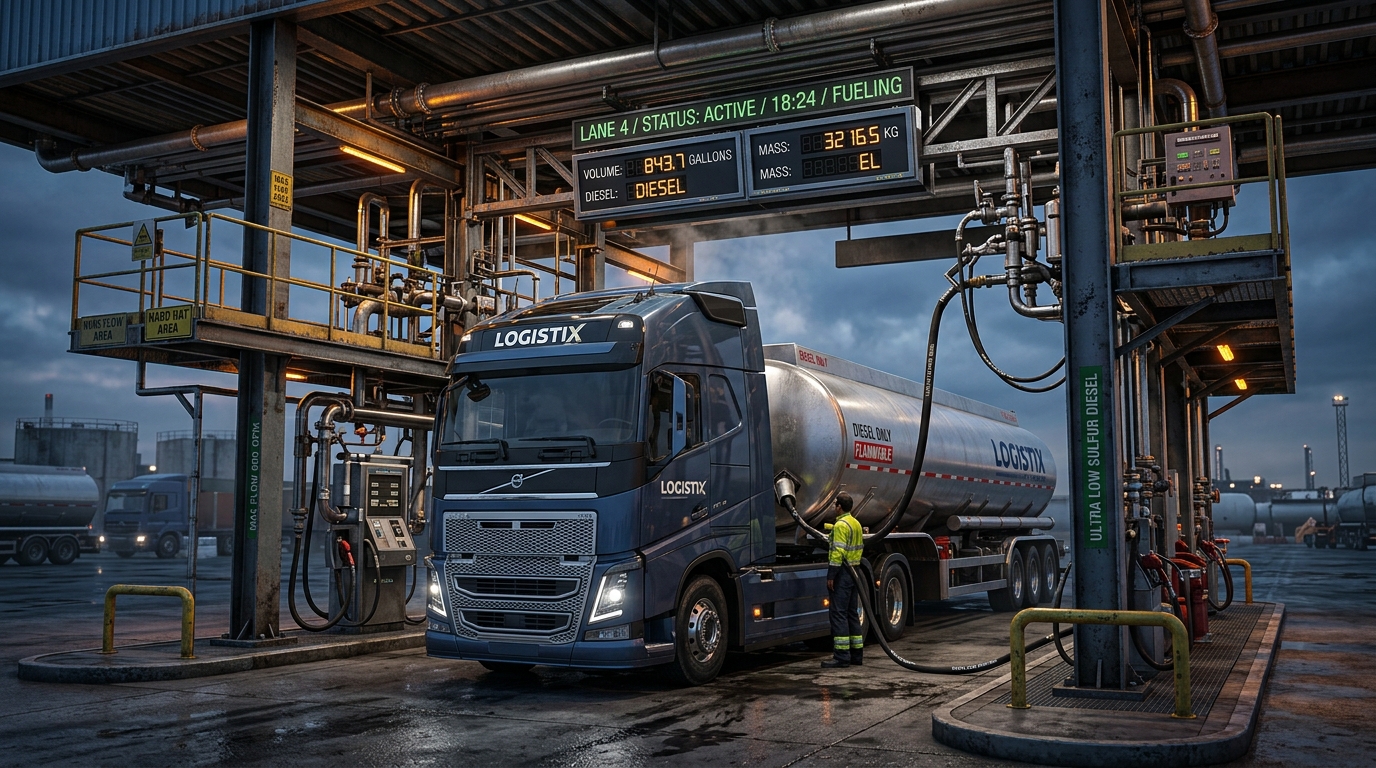
Diesel Fuel Density & Temperature Expansion: The Commercial Fleet Guide
For commercial freight carriers, heavy equipment operators, and bulk fuel purchasers, diesel fuel is often the single largest variable operating expense. Yet managing diesel inventory involves a critical technical challenge: diesel fuel is purchased in gross or net gallons, but road freight legality and vehicle stability are governed strictly by axle weight in kilograms and pounds.
A standard Class 8 heavy-duty tractor equipped with dual 150-gallon saddle tanks carries up to 300 US gallons of fuel. Depending on ambient temperature and crude feedstock density, that fuel alone weighs between 2,080 and 2,130 pounds (943 to 966 kg).
Failing to account for fuel mass and thermal volumetric expansion leads to two expensive consequences:
- DOT Weigh Station Fines: Incurring overweight penalties or out-of-service orders on highway weigh scales for exceeding the Federal Bridge Gross Weight limit (80,000 lbs) or individual axle limits (12,000 lbs steer / 34,000 lbs tandems).
- Terminal Inventory Discrepancies: Losing tens of thousands of dollars each month due to uncorrected temperature drift between terminal rack meters (Net Gallons @ 60°F) and bulk yard storage tanks (Gross Gallons).
This guide provides the definitive mathematical and engineering reference for fleet dispatchers, maintenance supervisors, and logistics managers.
1. ASTM D975 Standards & Diesel Chemistry
Automotive and commercial diesel fuel sold across North America is governed by ASTM D975: Standard Specification for Diesel Fuel Oils.
The specification classifies petroleum diesel into distinct grades:
Ultra-Low Sulfur Diesel #2 (ULSD 2-D S15)
The workhorse of commercial logistics:
- Maximum Sulfur Content: 15 ppm (0.0015%)
- Standard Reference Density @ 15.6°C (60°F): 0.832 kg/L to 0.850 kg/L
- Nominal Reference Density: 0.840 kg/L (7.01 lbs per US gallon)
- Energy Density: Approximately 138,500 BTU per US gallon (38.6 MJ/L)
Winter Diesel #1 (ULSD 1-D S15)
A lighter kerosene cut blended into winter fuel to prevent paraffin wax precipitation (gelling):
- Standard Reference Density @ 15.6°C (60°F): 0.810 kg/L to 0.825 kg/L
- Nominal Reference Density: 0.818 kg/L (6.83 lbs per US gallon)
- Energy Density: Approximately 135,000 BTU per US gallon (yielding ~2–3% lower fuel economy than #2)
Biodiesel Blends (B5, B20, B100)
Fatty Acid Methyl Ester (FAME) manufactured from soy, canola, or tallow oils is significantly denser than pure petroleum diesel:
- Pure Biodiesel (B100, ASTM D6751): Density of 0.880 kg/L (7.34 lbs/gal)
- B20 Blend (20% Bio / 80% Petro): Density of approximately 0.848 kg/L (7.08 lbs/gal)
2. API Gravity & The 60°F Commercial Billing Standard
In the petroleum industry, liquid density is commonly expressed using the American Petroleum Institute (API) Gravity scale, measured using specialized API hydrometers at a standardized temperature of 60°F (15.56°C).
The API Gravity Formula:
API Gravity (°API) = (141.5) / (Specific Gravity @ 60°F) - 131.5- Higher API Gravity indicates a lighter, less dense fuel.
- Lower API Gravity indicates a heavier, denser fuel.
Under ASTM D975, standard #2 diesel falls between 30° and 42° API:
- A fuel with 34° API has a specific gravity of 0.855 (7.13 lbs/gal).
- A fuel with 38° API has a specific gravity of 0.835 (6.97 lbs/gal).
       ┌──────────────────────────────────────────────────────────────────┐
       │ Gross Gallons = Actual Physical Volume Measured at Ambient Temp │
       │ Net Gallons   = Volumetric Equivalent Corrected to Standard 60°F │
       └──────────────────────────────────────────────────────────────────┘
When a fuel supplier delivers 8,500 gallons to your terminal:
- If the fuel was loaded at the refinery at 40°F (4.4°C), the fuel is cold and dense. The terminal bill of lading (BOL) may charge you for 8,500 Gross Gallons, but you received 8,570 Net Gallons of energy!
- If the fuel was loaded on a hot summer afternoon at 95°F (35°C), the liquid expanded. The delivery meter will dispense 8,500 Gross Gallons, but that volume corresponds to only 8,375 Net Gallons at standard 60°F—a net loss of 125 gallons of energy if invoiced on gross delivery.
3. Federal Bridge Gross Weight & Axle Weight Limits
In the United States, commercial motor vehicle weight on the Interstate Highway System is governed by federal law (23 U.S.C. 127) and the Federal Bridge Gross Weight Formula:
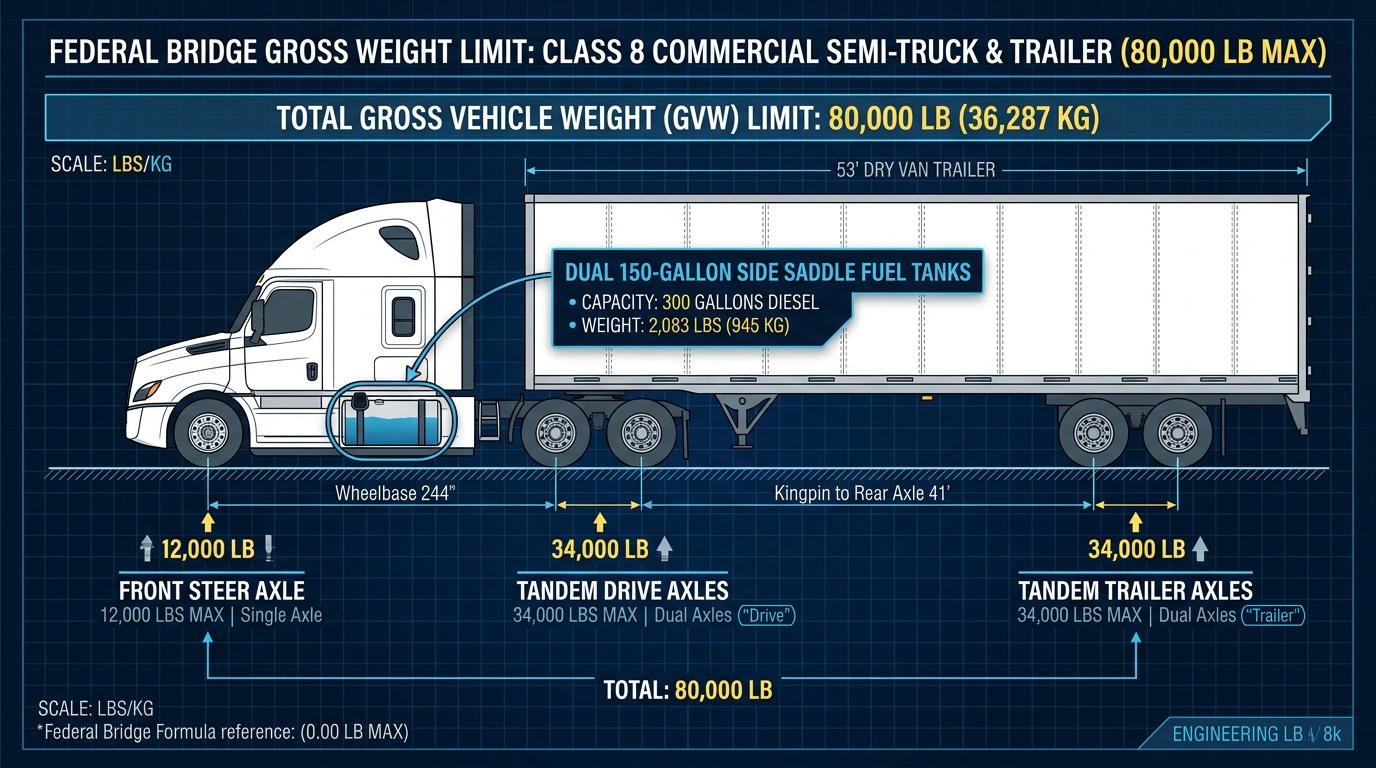
Standard Federal Axle Weight Limits for a 5-Axle Class 8 Tractor-Trailer:
- Steer Axle (Single): 12,000 lbs (5,443 kg)
- Drive Tandem Axles: 34,000 lbs (15,422 kg)
- Trailer Tandem Axles: 34,000 lbs (15,422 kg)
- Total Maximum Gross Vehicle Weight (GVWR): 80,000 lbs (36,287 kg)
How Fuel Weight Shifts Axle Loading:
On a typical cab-over or conventional tractor, the saddle fuel tanks are mounted directly behind the steer axle and immediately in front of the drive axles.
When a driver tops off dual 150-gallon tanks:
- Total Fuel Added: 300 gallons × 7.00 lbs/gal = 2,100 lbs (952.5 kg)
- Axle Distribution:
- Approximately 25% to 30% of that fuel weight transfers directly onto the steer axle (+525 to +630 lbs).
- Approximately 70% to 75% transfers onto the drive tandems (+1,470 to +1,575 lbs).
The Weigh Station Trap:
Consider a truck loaded with high-density freight where the pre-trip scale ticket at a shipper shows:
- Steer Axle: 11,600 lbs (Legal, max 12,000)
- Drive Axle: 33,200 lbs (Legal, max 34,000)
- Trailer Axle: 33,500 lbs (Legal, max 34,000)
- Gross Weight: 78,300 lbs (Legal, max 80,000)
- Fuel Level: Quarter tank (75 gallons remaining)
If the driver pulls into a truck stop and purchases 225 gallons of diesel (1,575 lbs):
- New Gross Weight: 78,300 + 1,575 = 79,875 lbs (Still legal under 80,000)
- New Steer Axle Weight: 11,600 + (0.28 × 1,575) = 12,041 lbs — OVERWEIGHT ON STEER AXLE!
The driver will be red-tagged at the next state Department of Transportation (DOT) weigh scale, receiving a citation and prohibited from moving until the fifth wheel is slid or excess weight is burned off or pumped out.
4. Temperature-Density Expansion Table for ULSD #2
The coefficient of thermal expansion for commercial diesel fuel #2 is approximately β ≈ 0.00083 /°C (0.00046 /°F).
The table below tracks how temperature shifts density, mass per gallon, and the total weight of a full 300-gallon fill:
| Temperature (°F / °C) | Density (kg/L) | Specific Gravity | Weight per US Gal | Weight of 300 Gallons (lbs) | Weight of 300 Gallons (kg) |
|---|---|---|---|---|---|
| -20°F (-28.9°C) | 0.865 | 0.865 | 7.22 lbs/gal | 2,166 lbs | 982.5 kg |
| 0°F (-17.8°C) | 0.857 | 0.857 | 7.15 lbs/gal | 2,145 lbs | 973.0 kg |
| 20°F (-6.7°C) | 0.849 | 0.849 | 7.08 lbs/gal | 2,124 lbs | 963.4 kg |
| 40°F (4.4°C) | 0.842 | 0.842 | 7.03 lbs/gal | 2,109 lbs | 956.6 kg |
| 60°F (15.6°C) (ASTM Base) | 0.834 | 0.834 | 6.96 lbs/gal | 2,088 lbs | 947.1 kg |
| 80°F (26.7°C) | 0.826 | 0.826 | 6.89 lbs/gal | 2,067 lbs | 937.6 kg |
| 100°F (37.8°C) | 0.819 | 0.819 | 6.83 lbs/gal | 2,049 lbs | 929.4 kg |
| 120°F (48.9°C) (Engine Return) | 0.811 | 0.811 | 6.77 lbs/gal | 2,031 lbs | 921.2 kg |
Fuel Return Thermal Expansion Warning:
Modern high-pressure common-rail (HPCR) diesel injection systems circulate up to 80% of pumped fuel back to the fuel tanks via return lines to cool and lubricate the injection pump. In summer operating conditions, fuel returning to the saddle tanks frequently reaches 120°F to 140°F (49°C to 60°C).
If cold fuel (50°F) is pumped into tanks and filled to the absolute filler neck, subsequent engine heat circulation and solar radiation will expand the liquid volume by 3% to 4%. In a 150-gallon tank, this generates 5 gallons of expansion volume, forcing fuel out through the tank breather vents onto hot tires and roadways unless an adequate expansion ullage (headspace) is preserved.
5. Converting Scale Weight (KG) to US Gallons
To convert measured diesel mass into gallons, use the certified density of your fuel:
Volume (US Gallons) = Mass (kg) / [ Density (kg/L) × 3.785411784 ]For standard ULSD #2 at nominal density (0.834 kg/L):
Conversion Multiplier = 0.834 × 3.785411784 = 3.15703Volume (US Gallons) = Mass (kg) / 3.15703Quick Conversions for Commercial Dispatch:
- 1 Metric Ton (1,000 kg) of Diesel #2 = 316.76 US Gallons (1,199.0 Liters)
- 1,000 US Gallons of Diesel #2 = 3,157.0 kg (6,960.0 lbs)
- 100 Pounds (100 lbs) of Diesel #2 = 14.37 US Gallons
6. Real-World Commercial Fleet Inventory Audit Example
Scenario: A freight terminal receives a transport tanker delivering ULSD #2. The bill of lading from the refinery rack indicates:
- Invoiced Quantity: 8,500 Net Gallons @ 60°F
- API Gravity: 35.0° API (0.8498 Specific Gravity)
- Rack Temperature: 42°F (5.6°C)
- Gross Truck Scale Weight on Arrival: 78,420 lbs
- Tare Truck Scale Weight after Offloading: 28,940 lbs
Audit Calculation:
- Net Fuel Weight Received:
Net Weight = 78,420 - 28,940 = 49,480 lbs (22,443.7 kg)
2. **Calculate Specific Weight per Gallon at Reference Standard (60°F)**:
   ```text
Density @ 60°F = 0.8498 × 8.3454 = 7.092 lbs/gal- Calculate True Net Gallons Delivered:
True Net Gallons = (49,480 lbs) / (7.092 lbs/gal) = 6,976.9 Gallons
4. **Reconcile Discrepancy**:
   Wait! The transport invoice billed for **8,500 Net Gallons**, but the scale ticket proves only **49,480 lbs** entered the tank (6,977 gallons).

   The audit immediately exposes a **1,523-gallon short-load** (worth over \$5,000 at current diesel prices) that would have gone undetected had the terminal manager simply relied on mechanical flow meters without cross-referencing scale weight!

---

## 7. Frequently Asked Questions (FAQ)

### What is the weight difference between #1 diesel and #2 diesel?
Number 1 diesel (kerosene blend) has a lower density (0.818 kg/L / 6.83 lbs/gal) than standard #2 diesel (0.840 kg/L / 7.01 lbs/gal). On a 300-gallon fill, switching to #1 winter diesel reduces your total vehicle fuel weight by approximately **54 lbs (24.5 kg)** while reducing fuel economy by about 2\% to 3\% due to lower BTUs.

### How much expansion space should I leave in my truck fuel tanks?
Commercial diesel tank manufacturers recommend never filling above **95\% of total water capacity**. Always leave approximately 2 to 3 inches of expansion headspace below the filler cap to prevent fuel blowback and overflow when the fuel absorbs engine return heat.

### Does diesel weigh more than gasoline?
Yes, significantly more. Regular gasoline has a density of approximately 0.745 kg/L (6.22 lbs/gal), whereas diesel #2 has a density of 0.834 kg/L (6.96 lbs/gal). Diesel is approximately **12\% heavier** than gasoline per unit volume.

### What is the API gravity of high-quality diesel?
Premium road diesel generally exhibits an API gravity between **34° and 38° API**. Fuel with an API gravity above 40° API is lighter and may indicate high kerosene content, while fuel below 32° API is dense, aromatic, and prone to higher particulate emissions and soot buildup.

---

## Fleet Manager's Summary & Quick Tools

To keep your fleet compliant and your fuel inventory balanced:
1. Standardize calculations using **7.00 lbs per gallon (0.839 kg/L)** for mixed operations.
2. In hot weather, account for 3\% volume expansion caused by engine return lines.
3. When loading close to the 80,000 lb gross limit, calculate fuel weight before scaling out.
4. Cross-reference bulk rack invoices with scale weight tickets to prevent short-fills.

Use our free interactive fleet calculation tools:
- [Universal Kg to Gallons Converter](/)
- [Diesel Fuel Weight & Density Calculator](/kg-to-gallons/diesel/)
- [Biodiesel (B20/B100) Conversion Tool](/kg-to-gallons/biodiesel/)
- [Gallons to Pounds Weight Converter](/gallons-to-pounds/)Perform Precision Mass-to-Volume Conversions
Use our live calculators calibrated to official ASTM, NIST, and NFPA temperature and density standards.