Commercial Liquid Food Density: Scale Weight to Gallons in Bottling & Processing
An industrial packaging guide explaining how food processors convert kilograms to gallons for honey, maple syrup, milk, and oils, featuring Brix refractometry and FDA net quantity compliance.
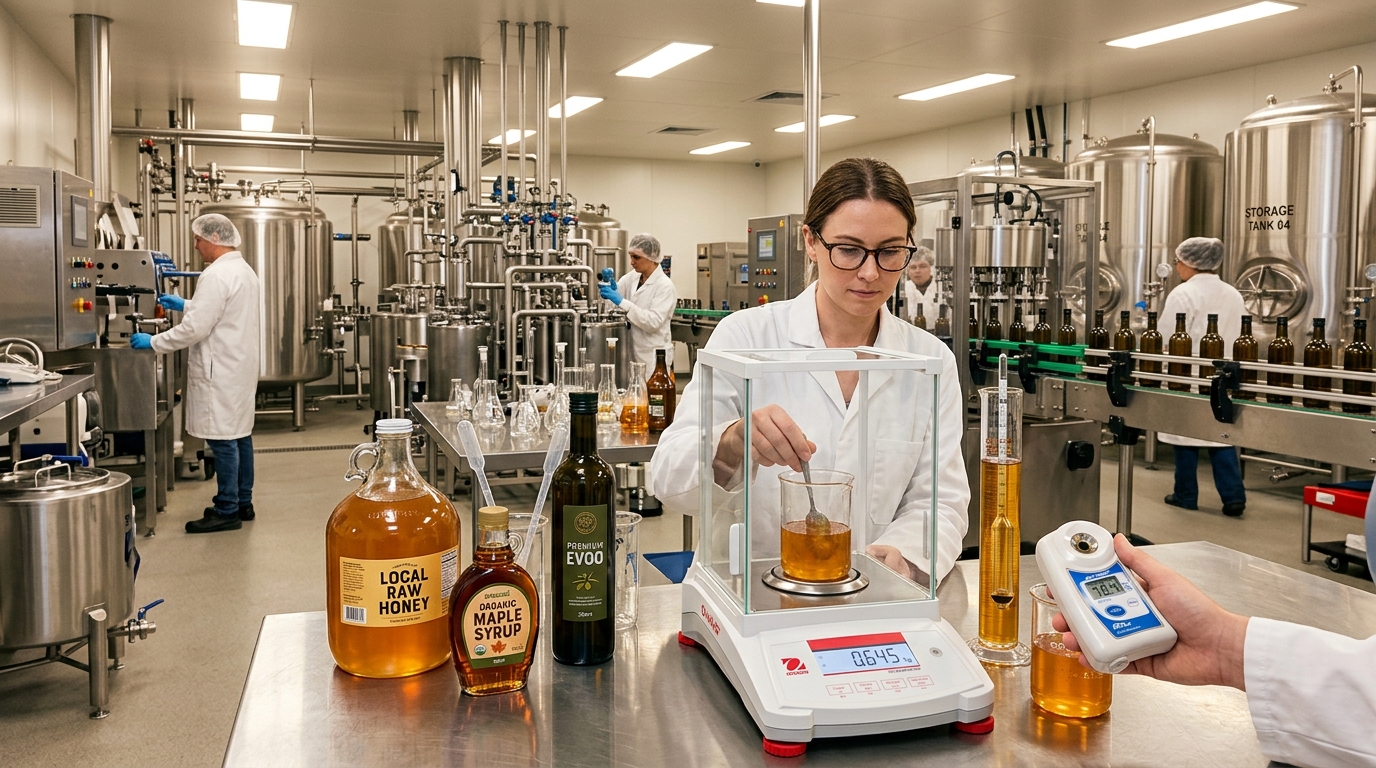
Commercial Liquid Food Density: Scale Weight to Gallons in Bottling & Processing
In commercial food processing, dairy packaging, and craft beverage manufacturing, plants operate under a fundamental engineering dilemma: industrial filling machinery measures mass in kilograms or pounds via precision high-speed load cells, but federal packaging regulations require consumer containers to be labeled in fluid volume (fluid ounces, quarts, or US gallons).
High-speed automated packaging lines cannot easily meter thick, viscous liquids like raw honey, maple syrup, or vegetable oils using simple volumetric flow meters. Viscous liquids entrain micro-air bubbles, foam, and cling tenaciously to pipes and nozzle walls, making volumetric turbine meters notoriously inaccurate.
Instead, state-of-the-art packaging lines use gravimetric net-weight filling: bottles ride across digital load cells that dispense product until an exact target mass in kilograms is registered.
To ensure legal compliance under FDA 21 CFR 101.105 and NIST Handbook 133 (Checking the Net Contents of Packaged Goods) without suffering crippling financial losses from product overfill (“giveaway”), processing engineers must master the relationship between density, temperature, sugar Brix, and volume.
1. Regulatory Framework: FDA Net Quantity & NIST Handbook 133
In the United States, commercial food packaging is enforced by state Departments of Agriculture (Weights and Measures divisions) operating under standards set by the National Institute of Standards and Technology (NIST) and the Food and Drug Administration (FDA):
1. The Legality of Liquid Volume Claims
Under FDA 21 CFR 101.105:
- A liquid food product (such as salad dressing, syrup, or milk) must declare its net contents in terms of fluid measure (e.g., 1 Gallon (3.78 L) or 16 FL OZ (473 mL)).
- The package is legally non-compliant if the actual liquid volume inside the container falls below the stated volume at the standardized reference temperature of 20°C (68°F) (or 4°C / 39.1°F for refrigerated dairy products).
2. Maximum Allowable Variations (MAV)
NIST Handbook 133 establishes statistical limits on package deficiencies:
- On a 1-gallon (128 fl oz) container, the Maximum Allowable Variation (MAV) is strictly limited to \pm 1.02 fluid ounces (30.2 mL).
- If state inspectors pull a random 12-container sample off a retail shelf and find the average net volume falls below the label claim, the entire production lot is slapped with a Stop-Sale Order, exposing the brand to severe civil penalties and public recall notices.
3. The Cost of Overfill (“Product Giveaway”)
To guarantee they never fail an inspection, naive packagers set filling nozzles to overfill containers by 2% to 3%.
On high-value specialty foods, this practice is economically disastrous:
- A processor packaging 500,000 gallons of pure Grade A maple syrup annually ($28.00/gal wholesale).
- An unnecessary 1.5% overfill wastes 7,500 gallons of product each year.
- Annual Financial Loss: $210,000 surrendered directly to customer giveaway!
Mastering exact mass-to-volume math allows processors to calibrate fill-weight cutoffs with sub-gram precision.
2. Viscosity vs Density: The Great Industry Misconception
One of the most pervasive mistakes on factory floors is confusing viscosity with density:
- Viscosity (μ): The internal friction or resistance of a fluid to flow, measured in centipoise (cP) or Pascal-seconds (Pa \cdot s). Viscosity describes how “thick” or “sluggish” a liquid behaves.
- Density (ρ): The mass per unit volume, measured in kg/L or lbs/gal. Density describes how “heavy” a liquid is.
       ┌─────────────────────────────────────────────────────────────┐
       │ High Viscosity DOES NOT mean High Density!                   │
       │ Example: Canola oil is ~50x thicker than water, yet oil     │
       │ has a density of 0.920 kg/L and floats on top of water!     │
       └─────────────────────────────────────────────────────────────┘
Motor oil and cooking oils are thick and slow-pouring, yet they are significantly lighter than water (0.915 to 0.925 kg/L). Conversely, concentrated salt brine or battery acid is thin and pours like tap water, yet has a high density (1.200 to 1.840 kg/L).
Always perform mass-to-volume conversions based strictly on density, never on visual viscosity.
3. Sugar Concentration: Degrees Brix (°Bx) & Specific Gravity
In commercial syrups, juices, honeys, and sauces, density is governed by the concentration of dissolved soluble solids—primarily sugars (sucrose, glucose, fructose). In food laboratories, this is measured using Degrees Brix (°Bx) with optical refractometers:
1° Brix = 1 gram of sucrose dissolved in 100 grams of pure water (1% w/w)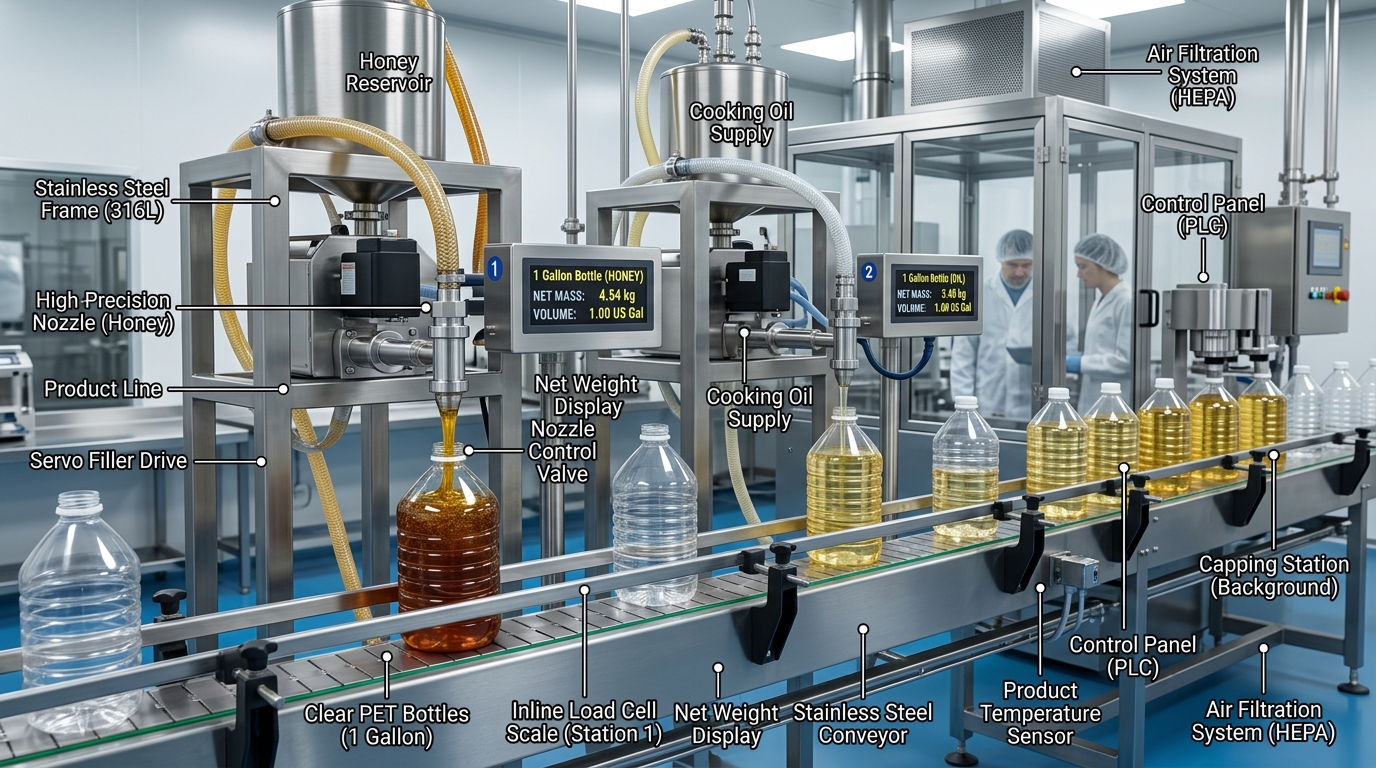
Mathematical Relationship Between Brix and Specific Gravity (SG):
For sucrose solutions at 20°C (68°F), specific gravity can be calculated with high precision using the empirical polynomial formula:
Specific Gravity (SG) ≈ 1 + (Brix) / (258.6 - 0.879 × Brix)Legal Quality Standards:
- Pure Maple Syrup (USDA Grade A): Must have a minimum sugar density of 66.0° Brix and no more than 68.9° Brix. At 66.0° Brix, maple syrup has a certified density of 1.330 kg/L (11.10 lbs/gal). Syrups below 66.0° Brix are illegal to label as Grade A and will ferment in storage; syrups above 68.9° Brix will crystallize rock sugar inside the bottle.
- Pure Raw Honey (US Grade A): Regulated by moisture content (≤ 18.6% water, corresponding to ≥ 80.0° Brix). Honey has a density ranging from 1.410 to 1.435 kg/L (11.77 to 11.97 lbs/gal).
4. Comprehensive Physical Properties of Food Liquids Table
The following reference table provides verified engineering values at standard room temperature (20°C / 68°F):
| Liquid Food Product | Standard Brix / Grade | Density (kg/L) | Weight per Gallon | 1 Gallon Net Mass (kg) | 1,000 kg Tote (US Gal) |
|---|---|---|---|---|---|
| Extra Virgin Olive Oil | 100% Cold Pressed | 0.918 | 7.66 lbs/gal | 3.475 kg | 287.8 gal |
| Canola / Vegetable Oil | Refined Commercial | 0.920 | 7.68 lbs/gal | 3.483 kg | 287.1 gal |
| Soybean Cooking Oil | Industrial Grade | 0.922 | 7.69 lbs/gal | 3.490 kg | 286.5 gal |
| Heavy Cream (36% Butterfat) | Grade A Dairy | 0.994 | 8.29 lbs/gal | 3.763 kg | 265.7 gal |
| Distilled Pure Water | Reference Standard | 0.998 | 8.33 lbs/gal | 3.778 kg | 264.7 gal |
| Distilled White Vinegar (5%) | 50 Grain Acidity | 1.006 | 8.39 lbs/gal | 3.808 kg | 262.6 gal |
| Whole Bovine Milk (3.7% Fat) | Grade A Pasteurized | 1.032 | 8.61 lbs/gal | 3.907 kg | 256.0 gal |
| Skim Milk (0.1% Fat) | Grade A Dairy | 1.036 | 8.65 lbs/gal | 3.922 kg | 255.0 gal |
| Soy Sauce (Standard Brewed) | 16% Salinity | 1.150 | 9.59 lbs/gal | 4.353 kg | 229.7 gal |
| Sweetened Condensed Milk | 8% Fat / 28% Milk Solids | 1.300 | 10.85 lbs/gal | 4.921 kg | 203.2 gal |
| Pure Maple Syrup | 66.0° Brix (Grade A) | 1.330 | 11.10 lbs/gal | 5.035 kg | 198.6 gal |
| High Fructose Corn Syrup 55 | 77.0° Brix Commercial | 1.375 | 11.47 lbs/gal | 5.205 kg | 192.1 gal |
| Blackstrap Cane Molasses | 79.5° Brix Heavy Cut | 1.400 | 11.68 lbs/gal | 5.300 kg | 188.7 gal |
| Pure Raw Honey | 80.5° Brix (17% Moisture) | 1.420 | 11.85 lbs/gal | 5.375 kg | 186.0 gal |
5. Automated Bottling Line Engineering: Target Weight Calculation
When programming an automated bottling machine equipped with gravimetric load cells, technicians input a Target Net Cutoff Weight (Target Mass) into the programmable logic controller (PLC):
Target Mass (kg) = Labeled Gallons × Density (kg/L) × 3.785411784Where:
- Labeled Gallons = Labeled container volume in US Gallons
- Density (kg/L) = Density of the liquid at current dispensing temperature
Thermal Temperature Drift Compensation
Liquid food products expand as temperature rises (β ≈ 0.0006 to 0.0008 /°C).
If olive oil is held in bulk staging tanks at 16°C (61°F), its density is 0.920 kg/L. If heated to 28°C (82°F) during filtration and pumping, the oil expands, lowering density to 0.912 kg/L.
If the PLC load cell was programmed with a static cutoff of 3.482 kg per gallon, dispensing oil at 28°C would deliver:
Actual Volume = (3.482 kg) / (0.912 × 3.78541) = 1.009 GallonsThe processor would inadvertently give away nearly 1% extra oil per bottle simply due to seasonal tank warming! Modern packaging lines incorporate inline temperature sensors to dynamically adjust target cutoff weights in real time.
6. Step-by-Step Industrial Packaging Worked Examples
Example 1: Bottling Pure Raw Clover Honey into 1-Gallon Jugs
Scenario: A commercial honey packing facility receives an order to fill 2,500 1-gallon clear jugs with pure raw clover honey. The refractometer reads 81.2° Brix with a temperature-corrected density of 1.422 kg/L.
- Calculate the Target Net Fill Weight per 1-Gallon Bottle:
Target Mass = 1.000 gal × (1.422 kg/L × 3.78541 L/gal) = 5.383 kg (11.867 lbs) - Calculate Total Raw Honey Mass Required for 2,500 Jugs:
Total Mass = 2,500 × 5.383 kg = 13,457.5 kg (29,668.7 lbs) - Tare Weight Setting:
The empty plastic 1-gallon jug and cap weigh 95.0 grams (0.095 kg). The scale’s gross shutoff trigger is set to:
Gross Scale Cutoff = 5.383 kg + 0.095 kg = 5.478 kg
Example 2: Reconciling an IBC Tote of Extra Virgin Olive Oil
Scenario: An artisan dressing manufacturer purchases a standard 1,000 kg Intermediate Bulk Container (IBC tote) of cold-pressed Italian Extra Virgin Olive Oil. The laboratory tests the specific gravity at 0.918 kg/L. How many 1-gallon bottles will this single tote yield?
- Calculate Total Volume in Liters:
Volume (L) = (1,000 kg) / (0.918 kg/L) = 1,089.32 Liters
2. **Convert Liters to US Gallons**:
   ```text
Volume (US Gal) = (1,089.32 L) / (3.785411784 L/gal) = 287.77 US Gallons- Production Packaging Yield:
Allowing 0.75% for pipe line cling, valve dead volume, and filter loss:
Usable Volume = 287.77 × 0.9925 = 285.6 Gallons
   The packaging manager can schedule **285 full 1-gallon bottles** with confidence.

---

## 7. Frequently Asked Questions (FAQ)

### Why does a gallon of honey weigh almost 12 pounds while a gallon of water weighs 8.34 pounds?
Honey is a supersaturated solution of sugars (approximately 40% fructose, 30% glucose, 10% other carbohydrates) with only 17% water. Sugar molecules are far heavier and pack more tightly together than pure water molecules. Because of this high dissolved solid concentration, honey has a density of 1.42 kg/L, making 1 gallon of honey weigh **11.85 lbs (5.37 kg)**—over 40% heavier than water.

### Can I use the same scale target weight for olive oil and canola oil?
Almost, but not quite. Extra virgin olive oil has a nominal density of 0.918 kg/L (7.66 lbs/gal), while refined canola oil has a nominal density of 0.920 kg/L (7.68 lbs/gal). On a 1-gallon container, the difference is only 8 grams. However, across a commercial run of 50,000 gallons, that 8 g discrepancy amounts to 400 kg (880 lbs) of product!

### What is the difference between a fluid ounce and an ounce by weight?
- **Ounce (oz by weight)**: A measure of mass equal to 1/16th of a pound (28.3495 grams).
- **Fluid Ounce (fl oz)**: A measure of volume equal to 1/128th of a US gallon (29.5735 mL).
Only pure water at 4°C exhibits an approximate 1:1 equivalency between fluid ounces and weight ounces (1 fl oz of water ≈ 1.043 oz wt). For dense honey, 1 fluid ounce weighs **1.48 ounces by weight** (42.0 g). For light oil, 1 fluid ounce weighs **0.96 ounces by weight** (27.2 g).

### How does pasteurization affect milk density?
Standard High-Temperature Short-Time (HTST) pasteurization (72°C for 15 seconds) does not significantly alter the chemical composition or density of milk once it cools back to standard refrigerated holding temperatures (4°C). Whole cow's milk retains a consistent density of **1.032 kg/L** (8.61 lbs/gal).

---

## Summary & Packaging Checklist

When converting scale mass to liquid container volume:
1. Always measure temperature and verify specific gravity or Brix using a calibrated digital refractometer.
2. Calculate target fill weight: **Target kg = Gallons × Density (kg/L) × 3.78541**.
3. Re-verify empty container tare weights at every shift change.
4. Integrate temperature compensation on automated gravimetric filling valves.

Use our free interactive calculators for precision food packaging and liquid conversions:
- [Universal Kg to Gallons Converter](/)
- [Raw Honey Weight & Volume Calculator](/kg-to-gallons/honey/)
- [Whole Milk & Dairy Gallons Tool](/kg-to-gallons/milk/)
- [Olive Oil & Cooking Oils Converter](/kg-to-gallons/olive-oil/)
- [Density Database for 50+ Liquids](/density-converter/)Perform Precision Mass-to-Volume Conversions
Use our live calculators calibrated to official ASTM, NIST, and NFPA temperature and density standards.