Aviation Fuel Density Standards: Converting Jet A & Avgas from KG to Gallons
A comprehensive flight operations guide explaining how pilots and dispatchers convert Jet A and Avgas from kilograms to gallons, ASTM D1655 standards, temperature correction, and lessons from the Gimli Glider.
Aviation Fuel Density Standards: Converting Jet A & Avgas from KG to Gallons
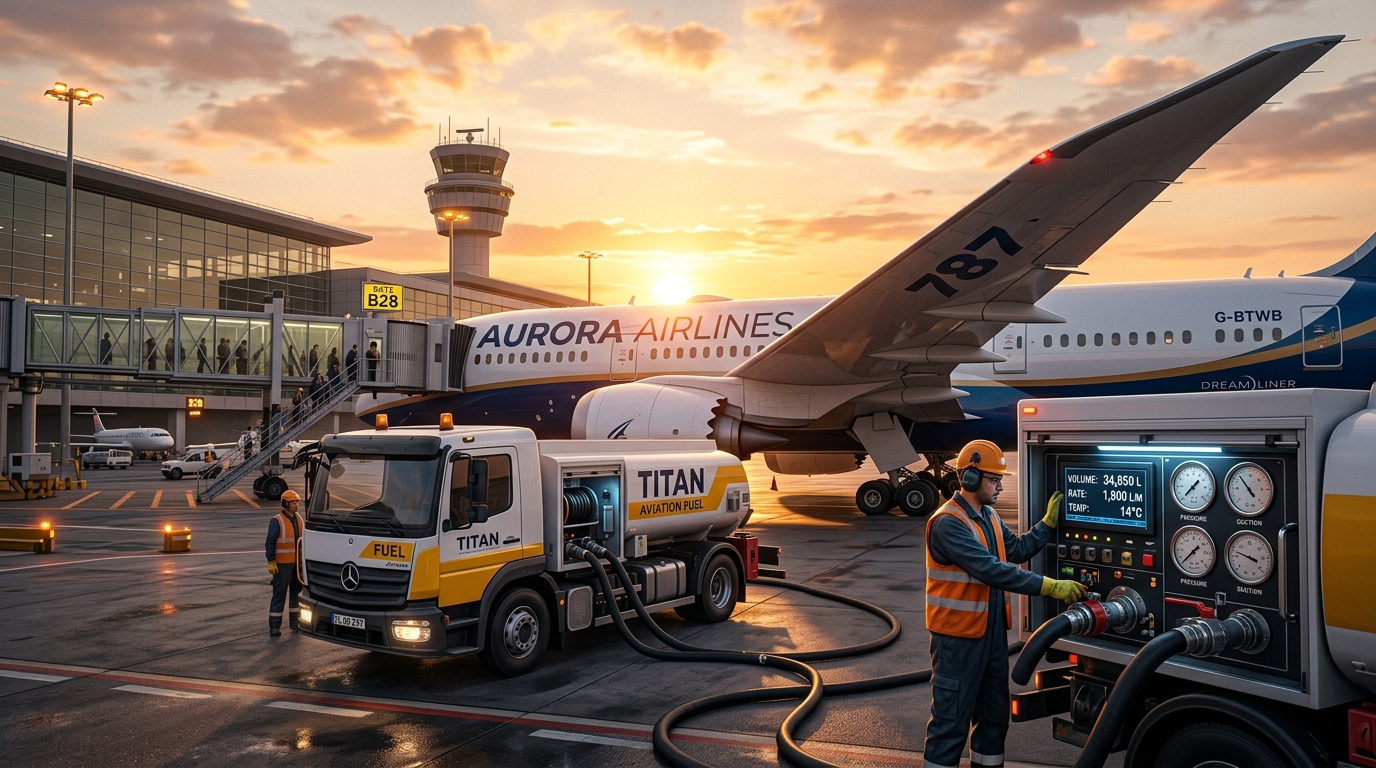
In commercial air transport and general aviation, fuel quantity calculations are governed by a critical operational paradox: flight dispatchers and Flight Management Computers (FMC) calculate fuel by mass (kilograms or pounds), but tarmac bowser trucks and airport hydrant systems dispense fuel by volume (liters or US gallons).
This distinction is vital to flight safety. An aircraft’s lift, climb performance, runway takeoff distance, and structural Maximum Takeoff Weight (MTOW) depend solely on the actual physical mass of the aircraft and its fuel payload. A jet engine burns chemical mass, not volumetric gallons.
Yet because liquid volume expands and contracts with every shift in ambient tarmac temperature, loading a set number of gallons without verifying fuel density can cause an airliner to take off dangerously overweight—or run out of fuel mid-flight.
1. The Historical Catalyst: The “Gimli Glider” Disaster (Air Canada Flight 143)
No incident illustrates the peril of mass-versus-volume conversion errors more dramatically than the celebrated case of Air Canada Flight 143 on July 23, 1983.
A brand-new Boeing 767 was scheduled to fly from Montreal to Edmonton. The aircraft was equipped with advanced digital avionics, but its Fuel Quantity Indication System (FQIS) was inoperative due to an intermittent soldering fault on a circuit breaker. Regulations permitted the aircraft to fly if ground crews manually measured fuel levels using magnetic dripsticks located on the wing undersides.
What Went Wrong in the Math:
- Ground technicians measured the fuel remaining in the tanks with the dripsticks, determining a volume of 7,682 liters.
- The flight plan required 22,300 kilograms of Jet A fuel for the trip.
- The crew needed to determine how many liters of fuel to order from the fueling truck.
- Because Canada was newly transitioning from Imperial to metric units, the ground crew and flight crew confused pounds and kilograms. Instead of multiplying by the metric Jet A density factor of 0.803 kg/L, they applied an Imperial factor of 1.77 lbs/L!
- Thinking the tanks held 13,597 kg of fuel, they calculated an uplift of only 4,916 liters, believing the total fuel on board was now 22,300 kg.
In reality, the aircraft took off with only 22,300 pounds of fuel—less than half of the required 22,300 kg (49,163 lbs).
At 41,000 feet over Red Lake, Ontario, both Pratt & Whitney turbofan engines flamed out completely. The crew skillfully glided the unpowered 130-ton airliner to an emergency landing on a former RCAF airfield in Gimli, Manitoba, which had been converted into a motorsports dragstrip.
Following this harrowing event, the International Air Transport Association (IATA) and the Federal Aviation Administration (FAA) instituted mandatory three-way independent cross-check protocols for all fuel density, mass, and volume calculations.
2. Regulatory Fuel Specifications: ASTM D1655 & ASTM D910
Commercial kerosene turbine fuels and general aviation piston fuels are manufactured under stringent international specifications:
Jet A and Jet A-1 (ASTM D1655 / Def Stan 91-091)
- Jet A: Used predominantly in the United States and Canada, with a freezing point of -40°C.
- Jet A-1: The global standard across Europe, Asia, and international operations, with a freezing point of -47°C.
- Standard International Baseline Density @ 15°C (59°F): 0.804 kg/L (6.71 lbs per US gallon).
- Allowable ASTM Density Range @ 15°C: 0.775 kg/L to 0.840 kg/L (6.47 to 7.01 lbs/gal).
Aviation Gasoline / Avgas 100LL (ASTM D910)
Used in piston-engine aircraft, 100LL is a high-octane, low-lead gasoline:
- Standard Baseline Density @ 15°C: 0.720 kg/L (6.01 lbs per US gallon).
- Allowable Range @ 15°C: 0.690 kg/L to 0.740 kg/L.
3. The Mathematics of Jet A Conversion: Mass (KG) to US Gallons
To convert Jet A mass in kilograms to volume in US liquid gallons, use the fundamental equation:
Volume (US Gallons) = Mass (kg) / [ Density (kg/L) × 3.785411784 ]When using the standard nominal baseline density of 0.804 kg/L:
Conversion Multiplier = 0.804 × 3.785411784 = 3.04347Volume (US Gallons) = Mass (kg) / 3.04347
Volume (Liters) = Mass (kg) / 0.804Avgas 100LL Conversion Multiplier:
For Avgas 100LL at baseline density (0.720 kg/L):
Conversion Multiplier = 0.720 × 3.785411784 = 2.72550Volume (US Gallons) = Mass (kg) / 2.725504. Tarmac Temperature Effects: The Density Drift
Jet fuel exhibits a high coefficient of thermal expansion (β ≈ 0.0010 /°C). When fueling an aircraft, the actual ambient temperature directly shifts fuel density and total tank volume requirements:
| Fuel Temperature | Jet A Density (kg/L) | Jet A Weight (lbs/gal) | Gallons per 10,000 kg Uplift | Fuel Volume Delta vs Baseline |
|---|---|---|---|---|
| -30°C (-22°F) (Winter Fairbanks) | 0.839 kg/L | 7.00 lbs/gal | 3,149 gal | -136 gal (-4.1%) |
| -15°C (5°F) (Winter Chicago) | 0.827 kg/L | 6.90 lbs/gal | 3,195 gal | -90 gal (-2.7%) |
| 0°C (32°F) (Freezing Spring) | 0.815 kg/L | 6.80 lbs/gal | 3,241 gal | -44 gal (-1.3%) |
| 15°C (59°F) (ASTM Standard Baseline) | 0.804 kg/L | 6.71 lbs/gal | 3,286 gal | 0 gal (Baseline) |
| 25°C (77°F) (Summer Moderate) | 0.796 kg/L | 6.64 lbs/gal | 3,319 gal | +33 gal (+1.0%) |
| 35°C (95°F) (Summer Dallas) | 0.788 kg/L | 6.58 lbs/gal | 3,352 gal | +66 gal (+2.0%) |
| 45°C (113°F) (Tarmac Dubai/Phoenix) | 0.780 kg/L | 6.51 lbs/gal | 3,387 gal | +101 gal (+3.1%) |
The “Tank Bumping” Problem in Extreme Heat:
Notice what happens in extreme heat (45°C): delivering 10,000 kg of Jet A requires 3,387 gallons compared to only 3,149 gallons in freezing conditions—a difference of 238 gallons for the exact same flight energy!
On long-haul international flights (e.g., Los Angeles to Sydney or London to Singapore) where an aircraft requires maximum fuel payload, extreme heat can cause the wings to physically run out of internal tank volume (“tank bumping”) before the required fuel weight in kilograms can be loaded. In such cases, the airline is forced to bump passenger baggage or reduce cargo payload.
5. Standard Flight Deck Refueling Workflow & Cross-Check
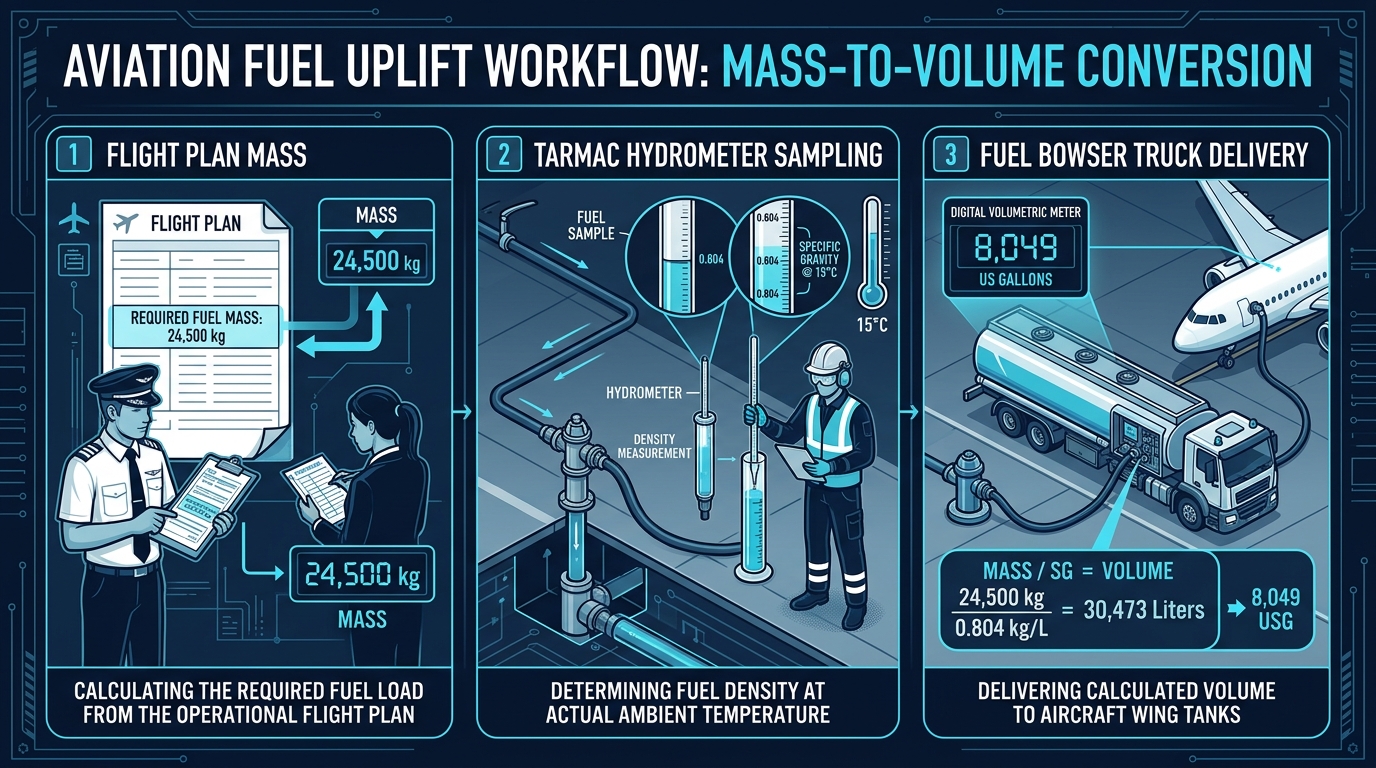
Before every commercial departure, the flight crew and fueling supervisor follow a standardized four-step verification sequence:
Step 1: Pre-Fueling Tank Dip & Quality Sample
The fueling agent draws a 1-quart sample from the bowser truck or hydrant pit. The sample is visually verified as “Clear & Bright” (free of suspended water droplets or particulate). A precision glass hydrometer and thermometer are inserted to record the actual tarmac fuel density (e.g., 0.798 kg/L at 22°C).
Step 2: Calculate Required Uplift Mass
The pilot-in-command cross-references the computerized flight plan (OFP):
Planned Total Fuel on Board (FOB) = 18,500 kgResidual Fuel in Tanks from Previous Flight = 4,200 kgNet Fuel Uplift Required = 18,500 - 4,200 = 14,300 kgStep 3: Compute Volume to Order from Fuel Truck
Using the hydrometer-tested density of 0.798 kg/L:
Volume (Liters) = (14,300 kg) / (0.798 kg/L) = 17,919.8 LitersVolume (US Gallons) = (17,919.8 L) / (3.785411784) = 4,733.9 US GallonsThe crew orders 4,734 US Gallons from the fueling technician.
Step 4: Post-Refueling Discrepancy Cross-Check
Once fueling is complete, the truck meter reading (V_metered) is multiplied by the verified density and compared against the cockpit FQIS gauge increase:
Calculated Mass Uplift = 4,734 gal × 3.78541 × 0.798 = 14,299.7 kgUnder standard airline flight operations manuals (FOM), the discrepancy between the cockpit gauge increase and the metered delivery cannot exceed \pm 3% or 500 kg (whichever is smaller). If the variance exceeds this limit, the aircraft is grounded until the discrepancy is investigated.
6. Real-World Calculation Example: Boeing 737-800 Flight
Flight Route: Denver (KDEN) to Miami (KMIA)
Aircraft: Boeing 737-800 (CFM56-7B engines)
Total Flight Plan Fuel Required: 11,800 kg (26,014 lbs)
Residual Fuel on Arrival: 2,100 kg (4,630 lbs)
Tarmac Fuel Hydrometer Reading: 0.801 kg/L @ 18°C
Execution:
-
Net Mass Uplift:
Net Uplift = 11,800 kg - 2,100 kg = 9,700 kg -
Volume in Liters:
Volume = (9,700 kg) / (0.801 kg/L) = 12,109.86 Liters -
Volume in US Gallons:
Volume (US Gallons) = 12,109.86 / 3.785411784 = 3,199.1 US Gallons -
Verification via Pounds per Gallon:
Jet A Density = 0.801 × 8.345404 = 6.685 lbs/gal
Mass in lbs = 9,700 × 2.20462 = 21,384.8 lbs
Volume = 21,384.8 / 6.685 = 3,198.9 US Gallons
The captain signs the fuel delivery ticket authorizing 3,200 US Gallons of Jet A.
7. Critical Differences: Jet A vs Avgas 100LL vs Automotive Gas (Mogas)
Pilots operating light aircraft often ask whether automobile gasoline (Mogas) can be used under Supplemental Type Certificates (STC):
| Metric | Jet A / A-1 | Avgas 100LL | Automotive Gas (Mogas 87/91) |
|---|---|---|---|
| Primary Base | Heavy Kerosene | Highly Refined Naphtha | Hydrocarbon Blend + Ethanol |
| Standard Density @ 15°C | 0.804 kg/L | 0.720 kg/L | 0.745 kg/L |
| Weight per Gallon | 6.71 lbs/gal | 6.01 lbs/gal | 6.22 lbs/gal |
| Engine Type | Turbofan / Turboprop / Jet | High-Compression Piston | Low-Compression Piston (STC) |
| Vapor Pressure (RVP) | Low (under 0.5 psi) | Medium (5.5–7.0 psi) | High (9.0–15.0 psi) |
| Vapor Lock Risk at Altitude | Negligible | Low | High (especially with ethanol) |
| Lead Additive | None (Unleaded) | Tetraethyllead (TEL) | None (Unleaded) |
Operational Warning: Never put Jet A into a piston aircraft engine or Avgas into a turbine engine without explicit airframe manufacturer and engine operational manual approval. Misfueling causes immediate engine catastrophic failure on takeoff.
8. Frequently Asked Questions (FAQ)
Why does the cockpit show fuel weight in kg when the truck meter shows gallons?
The aircraft’s Flight Management Computer (FMC) and weight-and-balance envelope are programmed entirely in mass (kg or lbs) because aerodynamic lift and engine thrust depend strictly on gravitational mass. Bowser trucks are commercial flow-measurement devices that mechanically meter volumetric fluid displacement. Converting metered volume to mass using the day’s verified hydrometer density bridges these two operational domains.
How much does 1,000 gallons of Jet A weigh?
At standard reference density of 0.804 kg/L (6.71 lbs/gal):
- In Pounds: 1,000 × 6.71 = 6,710 lbs
- In Kilograms: 6,710 / 2.20462 = 3,043.6 kg
Does cold jet fuel provide more engine range than hot jet fuel?
Yes! A gallon of cold jet fuel (-20°C) is denser than a gallon of hot jet fuel (+35°C), containing approximately 5% more mass and chemical energy (BTUs) per gallon. If your tanks are topped off to the physical brim with cold fuel, the aircraft carries more total energy and will fly significantly farther than if topped off with hot fuel.
What is the “Clear and Bright” test during refueling?
Before fueling begins, the technician samples fuel into a clean glass jar. The sample is visually inspected under sunlight. “Clear” refers to the absence of cloudiness or sediment (indicating zero suspended water droplets). “Bright” refers to the characteristic sparkling optical clarity of uncontaminated fuel. If water is present, water detection capsules (such as Shell Water Detector or Aquadis) turn bright blue or pink.
Summary & Operations Checklist
When converting aviation fuel between mass and volume:
- Always obtain the actual fuel hydrometer density and tarmac temperature from the fuel receipt.
- For quick estimations, use the international baseline multiplier: 1 kg Jet A = 0.3286 US Gallons (1 gal = 3.043 kg).
- Never mix up pounds and kilograms—verify all unit labels on both cockpit displays and dispatch release forms.
- Perform the mandatory 3-way reconciliation check before engine startup.
Explore our certified aviation and fuel conversion tools:
Perform Precision Mass-to-Volume Conversions
Use our live calculators calibrated to official ASTM, NIST, and NFPA temperature and density standards.